
Industrial chillers
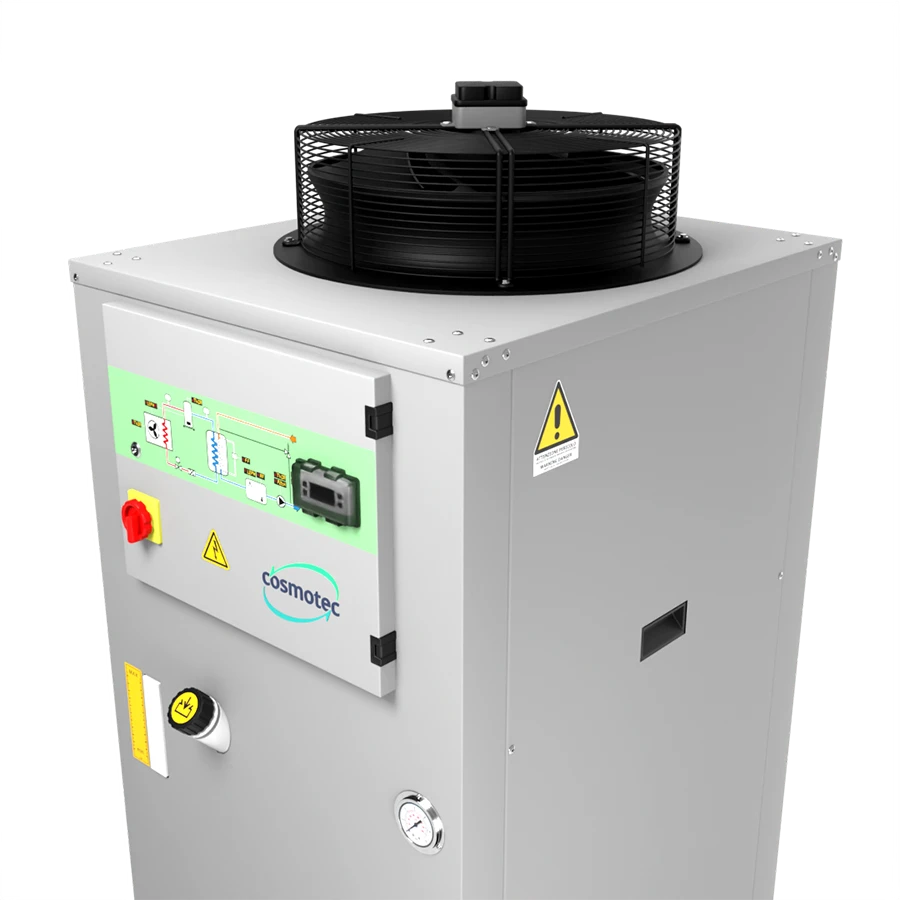
- AIR-COOLED R1234yf

WLA Compact
APPLICAZIONE INDUSTRIALE 1 – 5 kW Find out more: WLA Compact - AIR-COOLED R513A
WRA
APPLICAZIONE INDUSTRIALE 16 – 75 kW Find out more: WRA - AIR-COOLED R32
WLA Precision
APPLICAZIONE INDUSTRIALE 60 – 160 kW Find out more: WLA Precision - AIR-COOLED R32
WPA Mini
SCROLL COMPRESSORS 95 – 170 kW Find out more: WPA Mini - AIR-COOLED R454B
WPA
SCROLL COMPRESSORS 165 – 560 kW Find out more: WPA - AIR-COOLED R513A R1234ze
WSA/WSI
SCREW COMPRESSORS 280 – 1860 kW Find out more: WSA/WSI - WATER-COOLED R513A
WSW
SCREW COMPRESSORS 236 – 1529 kW Find out more: WSW - FOR OIL COOLING –
ORA
APPLICAZIONE INDUSTRIALE – Find out more: ORA


What is an industrial chiller?
Industrial water chillers are used in a wide variety of applications where chilled water or coolant is circulated through process equipment. They are characterized by an immediate response to changing load demands, the ability to modulate their cooling capacity, high control precision, and reliable performance even at the limits of their operating conditions. Industrial chillers are commonly used to cool products and machinery across a wide range of applications, including injection molding, machine tools, laser systems, the food and beverage industries, semiconductors, and many more.
Why use it?
No industrial process, machine, or motor is 100% efficient, and heat is the most common by-product of these inefficiencies. If this heat is not removed, it can cause machine downtime and even premature equipment failure. For this reason, it is essential to integrate cooling into the design of an industrial process in order to avoid these issues and increase its efficiency and reliability.
How does it work?
Process chillers contain a chemical compound known as a refrigerant and operate based on the fundamental principle of compressing the refrigerant and changing its phase from liquid to gas and back to liquid. The process that removes heat from a process fluid, based on the compression and expansion of the refrigerant, is known as the refrigeration cycle. The main components of the refrigeration circuit are:
- Evaporator: Heat exchanger in which the low-pressure, low-temperature gas/liquid mixture absorbs heat from the process water or water/glycol solution.
- Compressor: Supply the gas with the energy needed to change from low-pressure gas to high-pressure gas
- Condenser: Heat exchanger in which ambient air (or water) removes heat from the high-pressure gas, cooling it to a high-pressure liquid.
- Expansion valve:It allows the expansion of the refrigerant from a high-pressure, high-temperature liquid to a low-pressure, low-temperature gas/liquid mixture.
Air conditioning chillers or process chillers?
Process chillers are designed to operate at different temperatures, with various fluids and variable flow rates. They can be equipped with multiple pumps and multiple cooling hydraulic circuits, and they typically include a water tank that helps compensate for sudden changes in thermal load on the user side. This operational flexibility and high level of reliability are the main factors that distinguish them from comfort air-conditioning chillers. The assessment of the energy efficiency of an industrial chiller follows the requirements of European Regulation (EU) 2016/2281 for high-temperature chillers (SEPR HT) and (EU) 2015/1095 for medium-temperature chillers (SEPR MT).



Speak with one of our experts and find the ideal cooling solution for your system.
Our specialists are available to provide you with a detailed analysis and dedicated technical consulting.